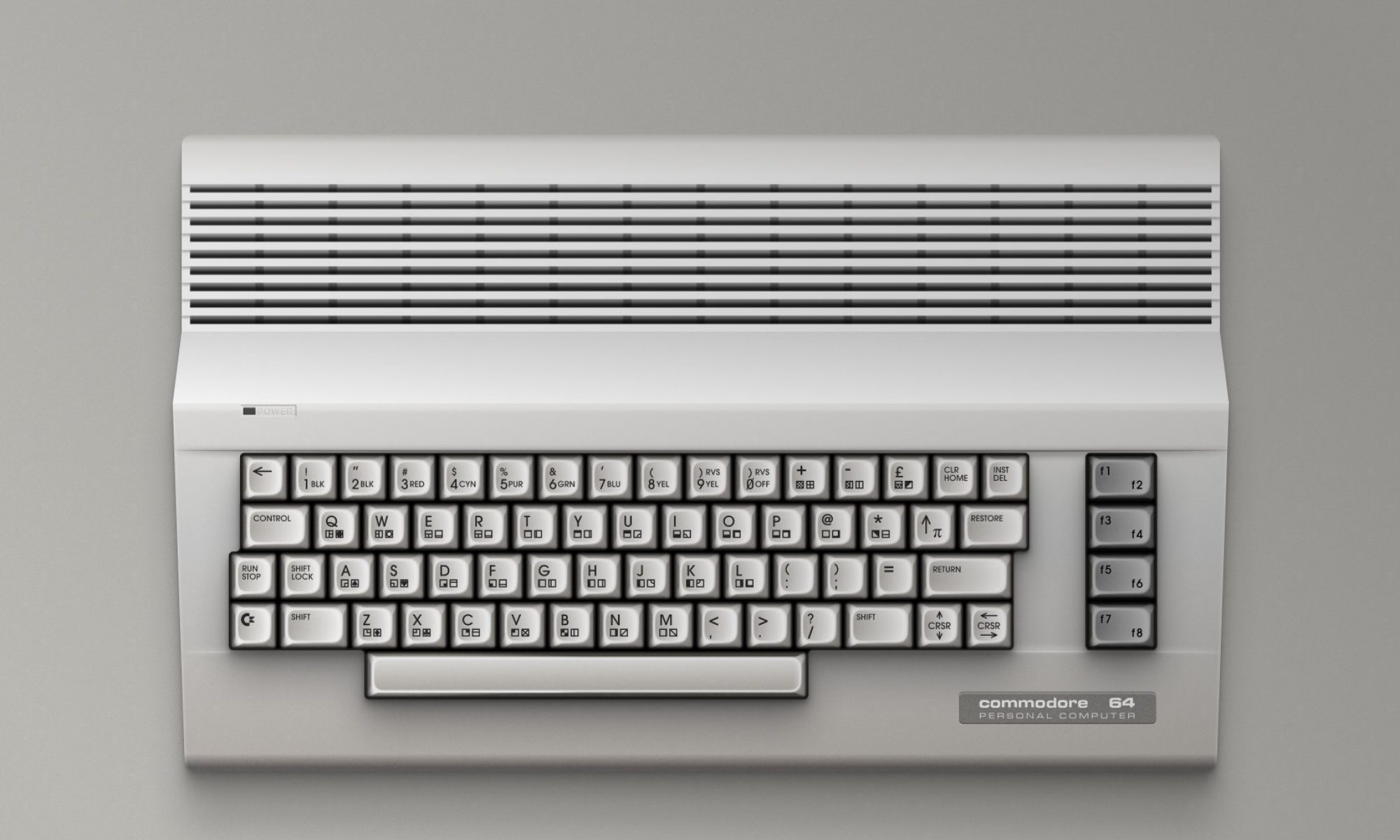

Since I wrote my article about the newly official Commodore 64 Ultimate, I have received a number of interesting and valuable comments thanks to my followers, from which I have now selected a question that others may later ask.
Hardware Architecture
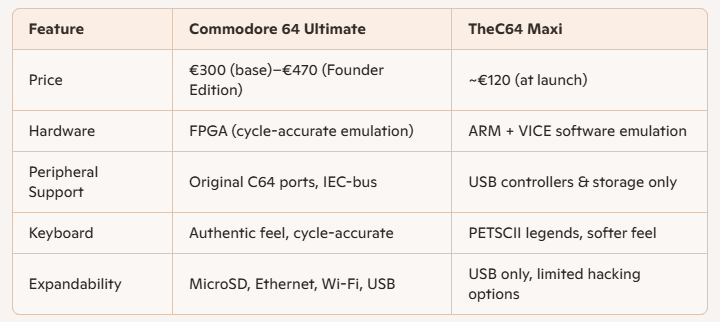
Commodore 64 Ultimate
- The internal logic is implemented on an AMD Artix 7 FPGA, providing cycle-accurate emulation of the VIC-II, SID and CIA chips.
- 128 MB DDR2 RAM and 16 MB of flash storage (firmware) replace the original 64 KB.
- Physical ports: HDMI/DVI output, 8-pin analog video DIN, three USB-A 2.0, 3.5 mm jack, S/PDIF, Wi-Fi, 100 Mbps Ethernet, and a MicroSD slot.

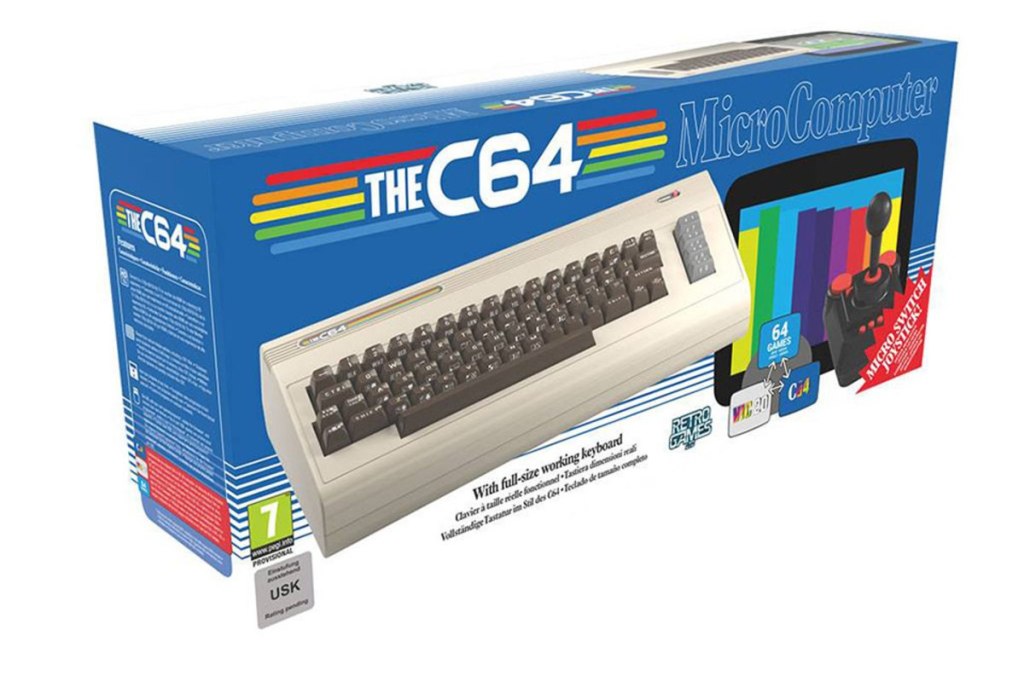
TheC64 Maxi
- A quad-core ARM processor runs the VICE emulator, software-simulating the C64 hardware.
- Ports: HDMI (720p), four USB, micro-USB power input. No analog video or original C64 ports.
- No native support for original joysticks, disk drives or Datasette—everything must connect via USB.
- Can be set to have RAM expansion.
Software Approach and Emulation
- The Ultimate’s FPGA-based core aims for 100% hardware fidelity, so most software runs at the original timing.
- The Maxi uses VICE 2.4; its SID emulation is serviceable but doesn’t support a second SID chip, so audio is mono rather than stereo.
- Both units accept firmware updates from USB flash drives; however, switching PAL/NTSC on the Maxi resets all settings to factory defaults.
Emulation and Latency
The C64 Maxi runs a VICE emulator on an ARM CPU that isn’t cycle-accurate, so audio (no stereo SID) and timing can be off, and menu navigation sometimes stutters. Controller input lag measures around 1–2 ms – but if your display adds lag, it stacks up. In contrast, the Ultimate’s FPGA-based, cycle-accurate core delivers virtually zero emulation glitches and imperceptible input delay.
Peripheral Support
- Commodore 64 Ultimate
- Two DB-9 joystick ports
- Cartridge and Datasette connectors
- Native support for original 1541/1530 drives and any IEC-bus CBM/C64 peripheral
- TheC64 Maxi
- USB-only joystick and storage support
- The included joystick is often criticized for cheap feel and sticky buttons—third-party USB controllers are recommended
- Since using the new firmware you can swap the joystick ports by pressing a combination of buttons on the joystick or game controller.
User Experience
- Keyboard
- Ultimate: authentic C64 layout with deep, firm keystrokes
- Maxi: retro styling with PETSCII legends and a softer press
- Menu/UI
- Ultimate: minimalist, direct BASIC prompt
- Maxi: “carousel” game-selection menu—intuitive but adds slight menu lag, you can also set TheC64 to boot to the classic direct Basic prompt.
- Input Lag
- The Maxi measures about 1–2 ms of lag, usually imperceptible in games; extra display lag can accumulate.
- Saving/Transfer
- Ultimate: via MicroSD or USB
- Maxi: USB-only (.d64/.crt files), no built-in file manager
Price-to-Performance
Annoying Physical Differences on TheC64 Maxi
- Only USB joystick support—no original DB-9 ports, so you need adapters.
- The stock controller feels cheap and prone to sticky buttons.
- No analog video output (HDMI-only at 720p), so you can’t hook it to CRTs or RGB mods.
- Power via micro-USB means you need a dedicated cable/adapter; it won’t boot from generic USB hubs.
- Switching PAL/NTSC resets to factory defaults—there’s no quick-select option in the menu.
Original storage peripherals compatibility
The Commodore 64 Ultimate hardware natively supports the following original C64 storage peripherals:
- Datasette port (6-pin edge connector) • Compatible with original tape drives such as the Commodore 1530 (C2N) and 1531
- IEC (disk drive) port (6-pin DIN) • Works with all stock floppy drives: 1541/1541-II, 1571, 1581 • Also supports any IEC-bus CBM/C64-compatible unit (e.g. 2040/4040, CMD series)
- Cartridge port • Runs all original cartridges (games, FastLoad, Action Replay, etc.) with 99%+ compatibility
The TheC64 (Mini/Maxi) in its stock form does not offer IEC or Datasette ports, so original disk and tape drives cannot be connected directly.
- USB mass storage
- USB flash drives or external HDDs: load .d64, .tap, .crt files into the VICE emulator
- USB floppy drive (as a FAT device)
- Physical 3.5″ PC floppies can be read, but only as FAT partitions — it won’t handle the GCR encoding used by original 1541 disks
Not supported:
- Original IEC-bus 1541/1571/1581 floppy drives
- Commodore 1530/1531 Datasette
- Any other CBM/C64-compatible analog storage peripheral
In summary, TheC64 only accepts USB-based image files (or FAT-based floppy media); it cannot natively read real disks or tapes.
You can decide but if you’re interested in the new Commodore 64 Ultimate and haven’t ordered it yet, you can do so here and now with some discounts:
Discover more from The Universe of Commodore 64
Subscribe to get the latest posts sent to your email.

LikeLike
LikeLike
Since only two USB-A ports are visible on the right side of the external case (both in photos and on the physical machine), the remaining port must be located inside the machine. This is common practice in modern FPGA-based machines (such as the Ultimate 64 or the new CBM Ultimate). Unfortunately, there is no positive confirmation of TheC64 USB joystick support on the official website. The specifications list “2 x DB9 Joystick ports” as the primary input mode. This confirms that the USB ports are primarily for peripherals (mouse, keyboard, storage) and not for direct HID game controllers.
LikeLike
2 USB Type A are present directly on mainboard while 1 USB Type C in on mainboard but used for connecting their mechanical keyboard.
However this mainboard has connector for accepting original C64 keyboard too, it’a awesome
LikeLike
I really don’t understand how you can compare two machines that were designed for two completely different purposes and whose only thing they have in common is the ability to run C64 games.One is a low-cost reproduction of the original machine with a Vice 2.4 emulator (so very old) mounted on an ARM SOC and connected to a non-mechanical keyboard of not excellent quality while the other is the recreation of the original machine totally in FPGA using the best motherboard by Gideon, the Ultimate 64 Elite 2 which integrates inside all the functions such as 2 Commodore drives (selectable between 1541, 1571 and 1581), a REU up to 16MB, the use of alternative ROMs both on the machine and on the drives (such as JiffyDos) (and even something more) of the Ultimate 2+, the most beautiful cartridge existing for the original C64, hosts the possibility of mounting 2 original SIDs (we know that the recreation in FPGA of the SIDs can NOT be perfect due to the analog part of the same), totally compatible or almost with the SW park and with the HW peripherals of the real C64, and with the It can use all the original outputs, including 15kHz CRT monitors or TVs, cartridges, the two DB9 ports of the original joysticks, and, ironically, even cool modern systems to replace legacy devices like the Cute32 or PI1541, as well as the Kung Fu Flash (although this would be wasted if it could read CRT and BIN files from the storage device).The C64 is ideal for the casual gamer who plugs it into the crappy, huge LCD in the living room and is content with that and its original joystick for gaming. The Commodore 64 Ultimate is designed for those who want the best today and tomorrow, and above all for those who want to support the reborn Commodore, hoping it can continue with other equally remarkable products.
LikeLike
On the one hand, this comparison was made because many people asked which one to buy before purchasing, and on the other hand, because most of them wanted to own such a modern device primarily for gaming and may not have trusted the original devices available second-hand. Not everyone wants to buy a Ferrari to get from point A to point B. Many people are happy if they can do so much more cheaply, and for them, a Suzuki, for example, is just as good.
LikeLike